Let me guess – you’re reading this while slumped in a chair that’s seen better days, probably rubbing your lower back and wondering why you feel like you’ve been hit by a truck after a day of Zoom calls. Sound familiar? You’re definitely not alone.
After spending countless hours researching and testing office chairs (yes, that’s actually part of my job!), I’ve learned that the right chair isn’t just about comfort – it’s about preserving your health, boosting your productivity, and honestly, not wanting to throw your laptop out the window by 3 PM.
The Wake-Up Call: Why Your Current Chair is Probably Hurting You
Here’s the thing nobody talks about when setting up a home office: that dining room chair you’ve been using for the past two years? It’s slowly destroying your spine. I know that sounds dramatic, but hear me out.
When you sit incorrectly for hours on end, your body starts compensating in weird ways. Your shoulders hunch forward, your lower back rounds out, and before you know it, you’re walking around like Quasimodo after work. This isn’t just discomfort – it’s your body sending you an SOS signal.
The medical term for what happens is “postural dysfunction,” but I prefer to call it “chair torture syndrome.” Your spine has natural curves that need support, and when your chair doesn’t provide it, everything goes haywire.
What Actually Makes a Chair “Orthopedic”?
I used to think orthopedic chairs were just marketing fluff – you know, slap the word “ergonomic” on anything and charge double. Boy, was I wrong.
Real orthopedic chairs are designed by people who actually understand how your body works. They’re built around the fact that your spine isn’t a straight line (shocking, I know), and that different parts of your body need different types of support.
Think of it this way: a regular chair is like wearing flip-flops to run a marathon. Sure, you can do it, but you’re going to pay for it later. An orthopedic chair is like having a personal trainer for your posture – it keeps everything aligned without you having to think about it.
The Non-Negotiable Features Your Chair Must Have
Lumbar Support That Actually Works
I can’t stress this enough – if your chair doesn’t have proper lumbar support, you might as well sit on a rock. Your lower back has a natural inward curve, and when that curve flattens out (which happens with poor chairs), that’s when the pain starts.
Good lumbar support should feel like a gentle hand pushing your lower back into the right position. It shouldn’t be aggressive or uncomfortable – just a firm, constant reminder to maintain that natural curve.
Pro tip: If you can adjust the lumbar support up, down, in, and out, you’ve found a winner. Everyone’s back is different, and one-size-fits-all lumbar support is like one-size-fits-all pants – technically possible, but probably not going to work well.
Height Adjustment That Makes Sense
Your chair should adjust so your feet sit flat on the floor with your thighs parallel to the ground. Sounds simple, right? You’d be amazed how many chairs get this wrong.
If your chair is too high, you’ll end up with pressure under your thighs that cuts off circulation. Too low, and your knees will be up around your ears like you’re sitting in a race car. Neither is fun for eight hours.
Armrests That Don’t Make You Want to Scream
Here’s where I get a little passionate: armrests should support your arms, not fight them. They should adjust in at least four ways – up and down, forward and back, wider and narrower, and ideally pivot left and right.
When your armrests are positioned correctly, your shoulders should feel relaxed, like they’re hanging naturally from your torso. If you feel like you’re shrugging or stretching to reach them, they’re not doing their job.
A Seat That Doesn’t Turn Into Concrete
The seat should be firm enough to support you but soft enough that you don’t feel like you’re sitting on a park bench. Memory foam sounds nice, but it tends to get mushy over time and lose its support.
High-density foam is your friend here – it keeps its shape and provides consistent support day after day. The seat should also be deep enough that there’s about two to three inches between the back of your knees and the edge of the seat.
My Top Picks: Chairs That Actually Live Up to the Hype
I know, I know – everyone talks about the Aeron. But there’s a reason it’s the chair you see in every fancy office and design magazine. After using one for six months, I can tell you it lives up to the hype.
The mesh design means you never get that sticky, sweaty feeling, even during marathon work sessions. The support is incredible without feeling restrictive, and the adjustments are intuitive enough that you don’t need an engineering degree to figure them out.
Yes, it’s expensive. But when you break it down over the 10+ years it’ll last, it’s actually pretty reasonable. Plus, your back will thank you every single day.
If the Aeron is the sports car of office chairs, the Leap V2 is the reliable SUV that gets you where you need to go in comfort. It’s got this amazing feature where the backrest actually changes shape as you move, which sounds gimmicky until you experience it.
The build quality is rock solid, and the adjustments are precise without being overwhelming. It’s particularly great if you tend to shift positions a lot throughout the day – the chair moves with you instead of fighting you.
This is what I recommend to friends who want Steelcase quality without the premium price tag. It has most of the important features – good lumbar support, quality build, proper adjustments – without some of the bells and whistles that jack up the price.
It’s proof that you don’t need to spend a fortune to get a chair that won’t destroy your back. The Series 1 does the job and does it well.
Sometimes you need a good chair but don’t have investment-level money to spend. The Ignition 2.0 gets the fundamentals right: adjustable lumbar support, breathable back, and solid construction.
Is it as refined as chairs costing twice as much? No. But it’ll support your back properly and last for years, which is what really matters.
The Setup: How to Actually Use Your New Chair
Getting a great chair is only half the battle. Setting it up correctly is where the magic happens, and honestly, most people get this wrong.
Start from the Ground Up
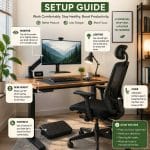
First, adjust the height so your feet are flat on the floor. If your desk is too high after doing this, get a footrest – don’t compromise on the chair height to accommodate a poorly positioned desk.
Next, tackle the lumbar support. Sit back in the chair naturally, then adjust the lumbar support so it sits right in that curve of your lower back. It should feel supportive but not pushy.
Get Those Arms Right
Adjust the armrests so your shoulders can relax completely. Your elbows should be roughly at a 90-degree angle when your hands are on your keyboard. If you have to lift your shoulders or let your arms dangle, the armrests need adjustment.
Find Your Sweet Spot
Most good chairs let you recline slightly – somewhere between 100 and 110 degrees is ideal. This takes pressure off your spine compared to sitting bolt upright, which actually puts more stress on your back than you’d think.
Beyond the Chair: Making Your Whole Setup Work
Your amazing new chair is part of a system. If your monitor is too low, you’ll crane your neck forward no matter how good your chair is. If your keyboard is too high, you’ll hunch your shoulders.
Make sure your monitor is at eye level – the top of the screen should be roughly at your eye level when you’re sitting naturally. Your keyboard and mouse should be positioned so you can reach them comfortably with your arms supported by the armrests.
The Real Benefits: What Changes When You Get This Right
The Immediate Wins
Within a day or two of switching to a proper orthopedic chair, you’ll notice you’re not constantly shifting around trying to get comfortable. You’ll stop having that “I need to stand up and stretch” feeling every 30 minutes.
Your energy levels will improve too. When your body isn’t working overtime to maintain an awkward position, it has more energy for actual work.
The Long-Term Payoff
This is where it gets really good. Proper support means less wear and tear on your spine, which translates to less pain and fewer problems down the road. I know it’s hard to think about your 60-year-old self when you’re dealing with today’s problems, but trust me – your future back will thank you.
Better posture also affects how you breathe, which affects how alert you feel. When you’re not slumped over, your lungs can expand properly, getting more oxygen to your brain. It’s amazing how everything connects.
The Productivity Boost
Here’s something I didn’t expect: when I stopped being distracted by discomfort, my focus improved dramatically. I wasn’t constantly thinking about my back or shifting positions every few minutes. That mental energy could go toward actual work instead of managing physical discomfort.
Keeping Your Investment Happy
A good orthopedic chair should last you at least 10 years with proper care. Here’s how to make sure yours goes the distance.
Basic Maintenance
Vacuum fabric chairs weekly to keep dust and debris from building up. For mesh chairs, a damp cloth with mild soap does the trick – just make sure to let it dry completely.
If you’ve got a leather chair, treat it like good leather shoes: clean it monthly and condition it every few months to keep it supple.
The Mechanical Side
Check the adjustment mechanisms every six months or so. If they’re getting sticky or hard to operate, a little lubricant usually fixes the problem. Most manufacturers have specific recommendations for what to use.
Keep an eye on the wheels too – hair and debris love to wrap around the axles, and cleaning them out occasionally keeps everything rolling smoothly.
Making the Call: How to Choose Your Perfect Chair
The truth is, the perfect chair is different for everyone. Your height, weight, work style, and even personal preferences all play a role in what’ll work best for you.
If possible, try before you buy. Many retailers have showrooms, and some manufacturers offer trial periods where you can return the chair if it doesn’t work out.
If you can’t try it first, stick with reputable manufacturers that offer good warranties and return policies. Read reviews, but remember that comfort is subjective – what works for someone else might not work for you.
The Bottom Line: Your Back is Worth the Investment
Look, I get it. Spending several hundred (or even over a thousand) dollars on a chair feels excessive. But when you consider that you’re potentially sitting in it for 40+ hours a week, and that back problems can cost thousands in medical bills and lost productivity, it starts to make sense.
Plus, a good chair will outlast several cheap ones, so the cost per year is actually pretty reasonable.
Your spine is the only one you’ve got, and it has to last you your entire life. Investing in proper support isn’t vanity – it’s practical health care.
Whether you go with a premium option like the Aeron or a solid mid-range choice like the Series 1, the important thing is getting off that dining room chair and giving your back the support it deserves. Your 3 PM self (and your future self) will thank you for it.
Remember: life’s too short to spend it in an uncomfortable chair. Your back has been carrying you around for years – isn’t it time you returned the favor?