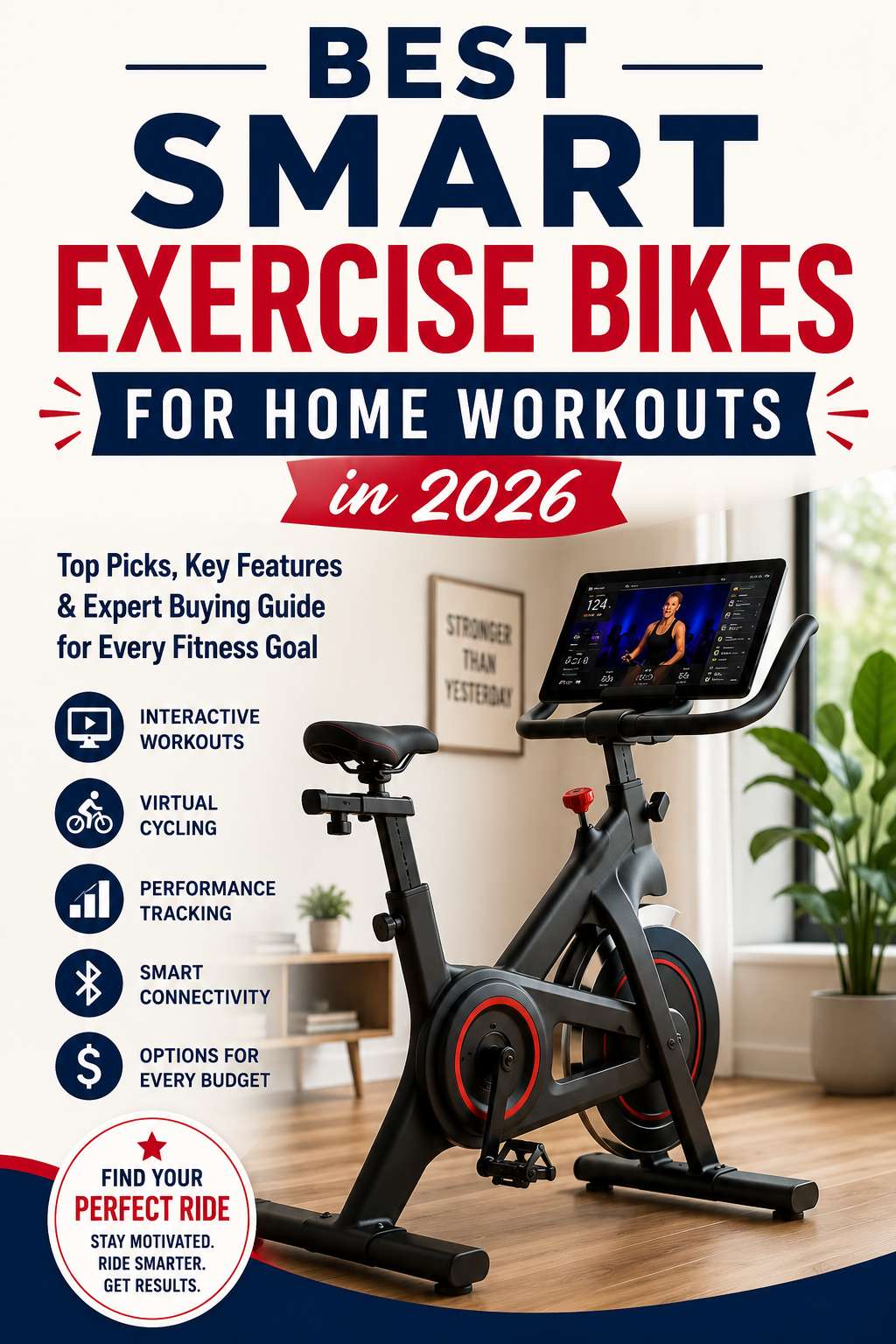
A smart exercise bike can turn a spare corner of your home into a surprisingly effective indoor cycling studio. Instead of simply pedaling while watching the clock, you can follow guided classes, ride virtual routes, track performance data, and, on some models, let the bike change resistance automatically as your workout progresses.
The challenge is choosing the right one. Smart exercise bikes vary widely in price, software, resistance systems, connectivity, and the type of workout experience they provide.
Some are built around instructor-led fitness classes. Others are designed for serious cycling training and virtual platforms such as Zwift. There are also simpler connected bikes that offer app compatibility without the cost of a premium touchscreen.
This guide looks at the best smart exercise bikes for home workouts and explains what separates them, who each model suits, and what to check before buying.
What Is a Smart Exercise Bike?
A smart exercise bike is a stationary cycling machine with electronic features that connect the workout to apps, devices, or online training platforms.
A basic exercise bike may show speed, time, distance, and estimated calories. A smart model can go much further. Depending on the bike, it may measure power and cadence, connect over Bluetooth or ANT+, respond to training apps, simulate hills, and automatically adjust resistance.
That connectivity is what makes indoor cycling more engaging.
For example, a virtual cycling app can tell the bike to increase resistance when you reach an uphill section. During a structured workout, resistance may change automatically between warm-up, recovery, and harder intervals.
The result is a workout that feels less repetitive and gives you more useful information about your performance.
Best Smart Exercise Bikes for Home Workouts
There is no single smart bike that suits everyone. The ideal choice depends on whether you care most about interactive classes, virtual cycling, accurate performance data, or keeping the cost under control.
Peloton Bike+ – Best for Interactive Home Workouts
Peloton Bike+ is one of the easiest recommendations for people who want a polished, motivating home fitness experience rather than a technical cycling workstation.
Its strength lies in the combination of responsive hardware and guided workouts. The large rotating display makes it possible to move from cycling to other types of exercise without needing another screen, while automatic resistance can reduce the need to adjust the bike manually during compatible workouts.
The appeal goes beyond cycling. The wider fitness platform includes strength sessions, mobility work, stretching, yoga, and other classes, making the bike more useful for households that want a broader workout routine.
The downside is the ecosystem. People who prefer to use a variety of independent cycling platforms may find a dedicated class-focused bike less flexible than a training-oriented smart bike.
Best suited to: Home users who enjoy instructor-led workouts and want an integrated fitness experience.
Zwift Ride with KICKR CORE 2 – Best for Virtual Cycling
The Zwift Ride takes a different approach. Instead of making the instructor the center of the experience, it puts virtual cycling at the forefront.
The system combines a dedicated indoor cycling frame with a smart trainer and controls designed for virtual riding. When paired with compatible software, resistance can react to simulated terrain, while virtual shifting adds another layer of control.
This makes it particularly attractive to riders who enjoy exploring virtual worlds, joining group rides, competing with others, or following structured cycling sessions.
It is also a practical option for households that want a dedicated indoor bike rather than repeatedly mounting an outdoor bicycle onto a trainer.
The main limitation is that its full potential depends on using compatible cycling software. Someone who only wants simple cardio sessions may not benefit enough from its more specialized features.
Best suited to: Gamified workouts, virtual routes, and cyclists who want a more interactive training environment.
Wahoo KICKR BIKE PRO – Best for Serious Cycling Training
The Wahoo KICKR BIKE PRO is aimed at riders who treat indoor cycling as real training rather than simply another form of cardio.
Its emphasis is on controlled resistance, connectivity, realistic gradient simulation, and accurate performance measurement. Instead of building the experience around a proprietary workout library, Wahoo focuses on making the bike compatible with a wider range of cycling software.
That flexibility is a major advantage. Riders who already use structured training programs or virtual cycling platforms can build the KICKR BIKE PRO into an existing setup.
It is also a better fit for people who care about metrics such as power output and cadence. These measurements can help cyclists monitor training load and progress more consistently than basic speed or calorie estimates.
The catch is the price. This is a premium machine, and casual users may never use enough of its capabilities to justify the additional expense.
Best suited to: Experienced cyclists and users who want a dedicated performance-training bike.
Garmin Tacx NEO Bike Plus – Best for Advanced Indoor Training
The Tacx NEO Bike Plus is another high-end option designed for riders who want a realistic and data-rich indoor cycling experience.
It provides advanced resistance control, simulated gradients, detailed performance tracking, and broad device connectivity. The bike is particularly interesting for cyclists who already use Garmin equipment or want to integrate indoor sessions with a broader training setup.
Its extensive fit adjustments are also useful when more than one person will use the machine. Proper bike positioning can make a major difference during longer rides, so this is an area where premium hardware has a practical advantage rather than simply adding more features to a specification sheet.
The NEO Bike Plus can be excessive for someone who wants occasional low-intensity cardio, but dedicated cyclists are more likely to appreciate what it offers.
Best suited to: Serious cyclists who value realistic resistance, detailed metrics, and extensive adjustability.
Echelon EX-8s – Best for an Immersive Fitness Setup
The Echelon EX-8s sits between traditional studio bikes and more performance-oriented smart trainers.
Its standout feature is the large curved display, which creates a more immersive experience for guided workouts. The bike is designed around connected fitness, so the visual experience plays a much larger role than it does on training-focused machines.
That makes it appealing for people who want something that feels closer to a dedicated home fitness studio. The adjustable setup and electronically controlled resistance also make it suitable for regular household use.
The trade-off is that it is a larger investment than a basic connected bike, and its biggest benefits are tied to the broader Echelon experience.
Best suited to: Users who prioritize a large screen and studio-style workouts.
Wattbike Atom Gen 3 – Best for Performance-Focused Cyclists
Wattbike’s Atom range is designed for cyclists who want a dedicated indoor machine capable of supporting serious training.
The Atom Gen 3 focuses on realistic resistance changes, structured sessions, virtual cycling, and detailed performance feedback. It is a particularly sensible choice for someone who wants the feel of a dedicated cycling setup without placing their outdoor bike on a trainer every day.
Another advantage is its fit flexibility, which can make it easier for different riders in the same household to share the bike.
Its biggest weakness is simple: most recreational riders do not need this much technology. The price and performance make more sense when indoor cycling is a serious part of your routine.
Best suited to: Enthusiasts and performance-minded cyclists.
Schwinn IC4 – Best Value for Connected Workouts
The Schwinn IC4 is an excellent example of why a smart exercise bike does not necessarily need a massive touchscreen.
It provides a straightforward indoor cycling platform with Bluetooth connectivity, allowing users to pair the bike with compatible apps and use their own phone or tablet for workout content.
That approach can save money while still providing a connected experience. It is particularly attractive to beginners who want to experiment with app-based cycling without committing to a premium smart-bike ecosystem.
You do give up some of the advanced automation and integrated hardware found on expensive models, but that may not matter when your goal is simply consistent home cardio.
Best suited to: Beginners and budget-conscious users who want app-connected indoor cycling.
How to Choose the Best Smart Exercise Bike
The best smart bike is the one that fits your workout habits. Before comparing prices, think about what you actually need.
Resistance and Ride Feel
Resistance determines how natural and challenging the bike feels.
Magnetic and electronically controlled systems generally provide smooth changes and can respond quickly to software commands. This becomes particularly useful when an app controls the resistance for you.
If you’re planning to train on simulated hills or follow interval programs, automatic resistance is far more useful than it may initially appear.
App and Platform Compatibility
Connectivity should be near the top of your checklist.
Some bikes are designed around a particular fitness ecosystem, while others work with several third-party platforms. Check compatibility before purchasing rather than assuming every Bluetooth-enabled bike works with every cycling app.
A bike with broad connectivity can remain useful for longer because you have more freedom to change your software or training platform later.
Power Accuracy
Power measurement matters most to cyclists who want meaningful training data.
Power, measured in watts, reflects the effort being produced at the pedals. It is useful for setting training zones, following structured sessions, and comparing performance over time.
For casual fitness, perfectly precise power data is not essential. For serious cycling, it can be one of the most important specifications on the entire bike.
Adjustability and Comfort
Do not treat fit as an afterthought.
The saddle, handlebars, and riding position should be adjustable enough to suit your body. This matters even more when two or more family members use the same bike.
A model with slightly fewer digital features but better fit can be a better long-term purchase than a feature-packed machine that never feels comfortable.
Screen or No Screen?
A built-in display is convenient, but it is not mandatory.
Premium bikes often include large touchscreens, while more affordable models allow you to use a tablet or television. If you already own a good tablet, spending extra on an integrated screen may not provide much practical value.
Consider what you will actually look at during a workout rather than choosing based on display size alone.
Smart Exercise Bike vs Traditional Stationary Bike
The main difference is feedback and interaction.
A traditional bike can still deliver an excellent cardiovascular workout. You can increase resistance, pedal at different speeds, and follow your own routine without any connected technology.
A smart exercise bike adds another layer. It can record performance data, control resistance electronically, connect to training platforms, and make workouts more varied.
For people who become bored easily, these features can be worthwhile. For someone who simply wants a machine for occasional cardio, a traditional or basic connected bike may offer better value.
Smart Bike vs Smart Trainer
These products serve slightly different needs.
A smart trainer works with a conventional bicycle, allowing you to turn an outdoor bike into an indoor training setup. This can be a great option for cyclists who already own a bike they love.
A smart exercise bike is a complete system. There is no need to mount your bicycle, change wheels, or adjust the setup every time you want to ride indoors.
A dedicated smart bike is generally easier for shared household use, while a smart trainer can be more attractive to committed outdoor cyclists.
Do Smart Exercise Bikes Require a Subscription?
The hardware itself may not require a subscription, but some of the software features you buy the bike for might.
This is an important distinction.
A bike may continue to function as basic exercise equipment without a membership, while premium classes, advanced workout libraries, coaching features, or virtual environments may require recurring payments.
Before buying, calculate the long-term cost rather than looking only at the price on the product page.
A cheaper bike with a costly required service may eventually cost more than a slightly more expensive model with fewer recurring expenses.
Common Smart Exercise Bike Problems and How to Fix Them
Even a well-designed connected bike can occasionally develop connection or performance issues. Many problems are relatively simple to solve.
The Bike Will Not Connect to Your App
Start by checking whether Bluetooth or ANT+ is enabled on the device running your fitness app.
If the app still cannot see the bike, close the app completely and restart it. This works because wireless pairing sessions can occasionally become stuck after a device wakes from sleep or switches between connections.
Also disconnect unnecessary Bluetooth accessories temporarily. A crowded wireless environment can make it harder to identify the correct fitness device.
If the bike has a companion app or firmware update available, install it because outdated firmware can cause compatibility problems with newer mobile operating systems.
Resistance Does Not Change Automatically
First confirm that the workout or app you are using actually supports automatic resistance.
Not every workout platform can control every smart bike.
If compatibility is confirmed, restart both the app and the bike. A fresh connection forces the software to establish a new control session rather than relying on a potentially interrupted connection.
You should also check whether the bike is connected to the correct device. If your phone, tablet, and another nearby computer are all trying to communicate with the bike, automatic control can behave unpredictably.
Power or Cadence Readings Look Wrong
Incorrect readings do not always mean the sensor is faulty.
Start by checking that the bike is properly calibrated according to the manufacturer’s instructions. Calibration helps the system establish a reliable reference point for resistance and power measurement.
Also check whether your riding position has changed or whether another sensor is being used by the app. In some setups, the app may display data from a separate connected sensor rather than the bike itself.
If readings remain obviously inconsistent after recalibration, compare them across another compatible application. That can help determine whether the problem is with the bike, sensor, or software.
The Bike Feels Noisy or Unusually Rough
A small amount of mechanical noise is normal, but a sudden change deserves attention.
Check that the bike is sitting level and that all accessible components are secure. A loose connection or uneven floor can create vibration that sounds like a drivetrain problem.
If the noise changes with pedaling speed, inspect the pedal and crank areas for obvious looseness. If the sound persists or becomes worse, follow the manufacturer’s maintenance guidance rather than continuing to ride through a possible mechanical fault.
The Workout App Keeps Disconnecting
Frequent disconnections often come down to wireless interference, distance, or device power settings.
Move the phone or tablet closer to the bike and disable aggressive battery-saving modes that may put the fitness app to sleep in the background.
Restarting both devices can also help because it clears temporary Bluetooth states and forces a new connection.
For longer sessions, keeping the mobile device plugged into power can prevent the operating system from limiting background activity.
Are Smart Exercise Bikes Worth the Money?
For regular users, they can be.
The real advantage is not simply technology for its own sake. A connected bike can make workouts easier to follow and easier to measure.
Virtual routes can make indoor riding more interesting. Automatic resistance can remove distractions during structured workouts. Performance data can help you see whether your fitness is actually improving.
But spending more does not automatically mean getting better results.
Someone who rides two or three times a week for general fitness may be perfectly happy with an affordable Bluetooth-connected model. A dedicated cyclist completing structured training several days a week will probably get much more value from a premium smart bike.
Final Verdict
The best smart exercise bike depends on how you want to train.
Peloton Bike+ is a strong all-round option for people who enjoy guided classes and want a polished home fitness ecosystem. Zwift Ride with KICKR CORE 2 makes more sense for riders who want immersive virtual cycling and interactive training. Wahoo KICKR BIKE PRO and Garmin Tacx NEO Bike Plus are better suited to serious cyclists who care about power, resistance control, and accurate training data.
Echelon EX-8s is worth considering when a large integrated display and studio-style experience are priorities, while Wattbike Atom Gen 3 is aimed more squarely at performance-focused riders. For shoppers who want connected workouts without paying premium-bike prices, the Schwinn IC4 remains a sensible starting point.
Before you buy, focus on the features that will affect your actual workouts: resistance control, app compatibility, fit, connectivity, power measurement, and overall ownership cost.
The best smart exercise bike is ultimately the one that makes you want to get on it consistently. When the hardware fits your needs and the software keeps your workouts interesting, indoor cycling becomes far easier to stick with.