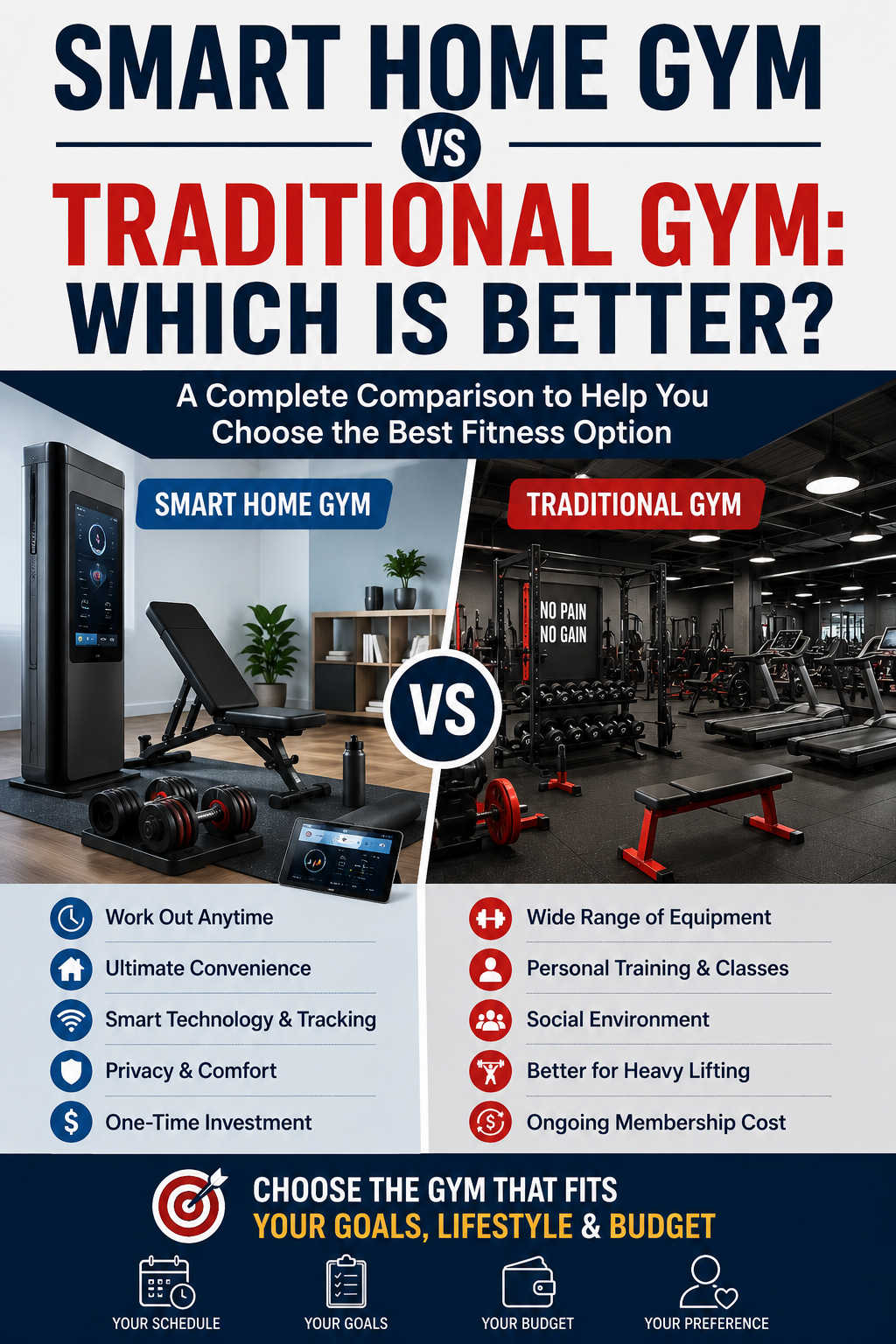
The decision between a smart home gym vs traditional gym is no longer as simple as choosing between working out at home or going to a fitness center. Connected fitness equipment has changed what a home workout can offer, with smart machines providing guided training, performance tracking, digital classes, and personalized workout data.
At the same time, traditional gyms still have a major advantage: access to a huge range of equipment, dedicated training spaces, personal trainers, and a social environment.
So which one is better?
The honest answer is that it depends on how you like to exercise, how much space you have, your budget, and—most importantly—what will help you stay consistent.
This comparison looks at the practical differences between smart home gyms and traditional gyms, including cost, convenience, equipment, technology, motivation, strength training, maintenance, and long-term value.
What Is a Smart Home Gym?
A smart home gym combines conventional exercise equipment with connected technology. Instead of simply lifting weights or using a treadmill, you may have access to digital coaching, workout programs, automatic performance tracking, resistance adjustments, heart-rate data, and progress reports.
Depending on the equipment, a smart fitness setup might include connected strength machines, adjustable weights, smart treadmills, exercise bikes, rowing machines, fitness trackers, or a workout platform accessed through a phone, tablet, or built-in display.
The main attraction is convenience. Your workout equipment is already at home, so exercising does not require a trip to another location.
Smart equipment can also make training more structured. Rather than deciding what to do every time you exercise, you can follow guided programs and use recorded performance data to monitor your progress.
What Does a Traditional Gym Offer?
A traditional gym provides access to a much broader collection of fitness equipment in one location. A well-equipped facility may have free weights, benches, squat racks, cable machines, resistance machines, treadmills, bikes, rowing machines, functional training areas, and group exercise spaces.
Many gyms also offer personal training. This can be particularly useful if you are learning unfamiliar exercises or want direct feedback about your technique.
Another advantage is the environment itself. For some people, physically going to a gym creates a clear separation between everyday activities and exercise. Seeing other people train can also provide motivation.
The trade-off is that you have to work around the facility’s location, opening hours, membership costs, crowds, and equipment availability.
Smart Home Gym vs Traditional Gym: The Key Differences
The biggest difference is convenience versus variety.
A smart home gym gives you immediate access to your workout space and can provide a highly connected training experience. A traditional gym gives you access to far more equipment without requiring you to purchase or maintain it yourself.
| Feature | Smart Home Gym | Traditional Gym |
|---|---|---|
| Convenience | Excellent | Moderate |
| Equipment variety | Good to excellent | Excellent |
| Privacy | Excellent | Limited |
| Digital tracking | Usually excellent | Depends on facility |
| Upfront cost | Higher | Lower |
| Ongoing membership cost | Often lower | Usually recurring |
| Space required | Yes | No |
| Heavy strength training | Depends on equipment | Excellent |
| Social environment | Limited | Strong |
| Personal training | Digital or optional | Often available |
| Maintenance | Your responsibility | Gym’s responsibility |
Neither setup is automatically better. The right choice depends on which disadvantages you are more willing to accept.
Cost: Is a Smart Home Gym Cheaper Than a Gym Membership?
Cost is one of the first things people consider, but looking only at the purchase price can give you the wrong impression.
A traditional gym usually has a relatively low starting cost. You pay a monthly or annual membership fee and gain access to equipment that would be extremely expensive to purchase individually.
A smart home gym works differently. The initial investment can be substantial because you are buying the equipment yourself. Some connected systems may also have optional or required subscriptions for advanced workouts, coaching, or other digital features.
However, the long-term calculation can change if you use the equipment for several years.
Consider transportation as well. If going to the gym requires fuel, public transportation, parking, or significant travel time, those costs can add up. A home setup eliminates most of them.
The important question is not simply, “Which costs less?” It is which option provides better value for how often you will use it?
An expensive home gym that rarely gets used is poor value. A modest setup that supports regular workouts can be a much smarter investment.
Convenience and Time: Where Home Gyms Have a Major Advantage
For busy people, convenience can be more important than almost anything else.
With a home gym, you can start exercising within minutes. There is no commute, no waiting for equipment, and no need to plan your workout around a gym’s busiest periods.
That makes it easier to fit short sessions into a busy day.
A traditional gym can turn a 30-minute workout into a much longer commitment once travel, changing, parking, and waiting for equipment are included.
That does not make traditional gyms inconvenient for everyone. Someone who lives close to a well-equipped facility may have no problem visiting regularly.
But if travel is one of the reasons you frequently skip workouts, bringing your training equipment home can remove a significant barrier.
Equipment Variety: Traditional Gyms Still Win
This is one area where traditional gyms have a clear advantage.
A commercial fitness center can provide dozens of machines and free-weight options without requiring you to buy or store them. You can move from a cable machine to a bench, then to a treadmill or rowing machine without changing locations.
A home gym is limited by your budget and available space.
Smart equipment can be surprisingly versatile, particularly when adjustable resistance or multiple exercise modes are available. However, one machine rarely provides the same range as an entire commercial gym.
If you enjoy changing your training style or need specialized equipment, a traditional gym is usually the more flexible choice.
Strength Training: Which Is Better?
The answer depends on your training level.
For general strength and fitness, a smart home gym can be more than adequate. Connected resistance equipment, adjustable weights, benches, and resistance bands can support a wide range of workouts.
Traditional gyms have the advantage for people who need heavier loads or specialized strength equipment. A good facility may provide Olympic barbells, power racks, multiple benches, heavy dumbbells, cable systems, and machines designed for specific muscle groups.
That extra equipment becomes increasingly useful as your training becomes more specialized.
If your goal is general fitness, you probably do not need a commercial gym’s enormous equipment selection. If your workouts depend on heavy or highly specific strength equipment, the traditional gym becomes more attractive.
Cardio Training at Home vs the Gym
Cardio is a closer comparison.
A traditional gym may have treadmills, ellipticals, stationary bikes, stair machines, rowers, and other equipment. Having several options can make it easier to vary your workouts.
At home, you need to purchase each machine yourself. A smart treadmill or exercise bike can provide an excellent training experience, but buying several large machines is expensive and takes up substantial space.
For someone who mainly runs, cycles, or rows, purchasing one suitable machine may make sense. If you enjoy experimenting with many types of cardio, a traditional gym provides greater flexibility.
Smart Fitness Technology and Workout Tracking
Technology is one of the strongest reasons to choose a smart home gym.
Connected equipment can record workout information and make your training easier to measure. Depending on the system, you might be able to monitor resistance, repetitions, workout duration, heart rate, calories, training volume, and progress over time.
That information can help you identify whether your workouts are actually becoming more challenging or consistent.
Traditional gyms can offer similar tracking through fitness watches, smartphone apps, or separate workout logs, but the experience may require more manual input.
Still, smart technology should be treated as a tool rather than a substitute for good training habits. More data does not automatically produce better results.
Motivation: Home or Gym?
Motivation is highly personal, which makes this one of the hardest categories to declare a winner.
A traditional gym can create accountability simply because you have made the effort to go somewhere. Group classes, training partners, instructors, and other members can provide additional motivation.
For other people, that same environment is distracting or uncomfortable.
A home gym removes those obstacles. You can exercise privately and follow a structured digital workout without worrying about crowded equipment.
The potential downside is that home has plenty of distractions. Television, phones, household chores, and the temptation to postpone your workout can all interfere.
The best setup is therefore the one that makes consistent exercise easier for you, not the one with the most impressive technology.
Privacy and Comfort
If you dislike exercising around other people, a home gym offers an obvious benefit.
You control the environment, the music, the temperature, and the schedule. You also do not have to wait for equipment or feel self-conscious while learning a new movement.
Traditional gyms can be busy, particularly during evenings and weekends. Some people enjoy that energy, while others find it distracting.
There is no universally correct preference here. Privacy is valuable if it makes you more comfortable and more likely to exercise.
Maintenance and Technical Problems
One advantage of traditional gyms is that equipment maintenance is generally not your responsibility.
If a treadmill stops working or a cable machine develops a problem, the facility handles the repair. You simply move to another piece of equipment.
With a smart home gym, you own the equipment and therefore take responsibility for basic maintenance.
Connected equipment can also introduce problems that traditional equipment does not have, such as software updates, connectivity failures, app issues, sensor problems, or subscription restrictions.
If a smart machine stops connecting to its app, start by checking the basics: confirm the internet connection, restart the equipment and app, and install available firmware or software updates. These steps work because many connectivity problems are caused by temporary communication errors or outdated software rather than physical hardware failure.
If tracking data suddenly looks inaccurate, check whether the correct user profile and equipment settings are selected. Incorrect profiles, resistance settings, or sensor positioning can cause the system to record misleading information.
And if the equipment works normally but a premium feature is unavailable, check the subscription terms before assuming something is broken. Some smart fitness platforms intentionally place advanced content behind a recurring membership.
Space and Noise Considerations
A home gym needs physical space, and that requirement is easy to underestimate.
You need enough room not only for the equipment itself but also for safe movement around it. Larger machines may also require suitable electrical outlets, ventilation, or clearance.
Noise is another consideration, especially in apartments.
Running on a treadmill, dropping weights, or moving heavy equipment can transmit vibrations through floors and walls. A suitable exercise mat can reduce some vibration and protect the floor, although it cannot make loud equipment completely silent.
If space or noise is a serious concern, a traditional gym may be the more practical option.
Smart Home Gym vs Traditional Gym for Beginners
Both options can work well for beginners, but they solve different problems.
A smart home gym can reduce the intimidation factor because you can learn movements privately and follow guided sessions at your own pace.
A traditional gym, meanwhile, provides access to trainers and a much wider range of equipment. That can be valuable if you want someone to explain exercises or correct your technique.
If you are new to resistance training, focus on learning proper form rather than chasing heavier weights or more complicated workouts. Good technique provides a stronger foundation regardless of where you train.
Which Is Better for Busy People?
For people with demanding schedules, a smart home gym often makes more practical sense.
Removing the commute means you can turn a limited amount of free time into actual exercise. Even a short workout becomes easier to complete when the equipment is already nearby.
That convenience can have a powerful effect on consistency.
However, a traditional gym may still be better if leaving home helps you mentally switch into workout mode. The key is to identify whether travel is your obstacle or your motivation.
Is a Hybrid Gym Setup Worth Considering?
You do not necessarily have to choose one option permanently.
A hybrid approach combines a compact home setup with a traditional gym membership. For example, you could use home equipment for short workouts on busy days and visit the gym when you need heavier weights or specialized machines.
This approach costs more than choosing one option, but it can provide considerable flexibility.
It is most useful for people whose schedules change frequently or whose training needs are too varied for a small home setup alone.
Who Should Choose a Smart Home Gym?
A smart home gym is particularly suitable if convenience, privacy, flexible scheduling, and digital workout tracking are high priorities.
It can also be a good choice when traveling to the gym regularly is difficult or when you prefer structured workouts rather than designing every session yourself.
Before buying, though, make sure you have enough space and that the equipment actually supports the exercises you plan to perform. Avoid paying for advanced features you are unlikely to use.
Who Should Choose a Traditional Gym?
A traditional gym is usually the stronger option if you want maximum equipment variety, heavy strength-training facilities, group classes, personal training, or a social workout environment.
It also makes sense if you do not have suitable space at home.
The biggest advantage is that you can access expensive equipment without having to purchase, store, or maintain it yourself.
Smart Home Gym vs Traditional Gym: Final Verdict
So, is a smart home gym better than a traditional gym?
There is no single answer that works for everyone.
A smart home gym is the better choice when convenience, privacy, connected technology, and flexible scheduling are your priorities. It can remove the friction between deciding to exercise and actually starting your workout.
A traditional gym is usually better when equipment variety, heavy strength training, personal instruction, group activities, and social motivation matter more.
The most important factor is not how advanced the equipment is. It is whether the setup fits your lifestyle well enough that you will use it consistently.
If you regularly skip the gym because of travel or scheduling, a smart home gym could solve the problem. If you feel more motivated in a dedicated fitness environment or need specialized equipment, a traditional gym may serve you better.
And if both options solve different problems for you, a hybrid setup can offer a practical middle ground.
Ultimately, the best gym is the one that removes your biggest barriers to exercise and makes regular training feel realistic rather than difficult to maintain.
You might also like,
Best Smart Fitness Equipment for Small Home Gyms in 2026: Top Space-Saving Picks for Every Budget